
If you’ve gotten quotes from multiple forklift service vendors, you’ve probably noticed something strange: the prices vary wildly. One vendor quotes $200 per PM visit. Another quotes $500. A third proposes a flat monthly rate that includes everything. The agreements all sound similar at the headline level, but the dollar amounts can differ by a factor of two or three, sometimes more.
Thank you for reading this post, don't forget to subscribe!The variance isn’t random. It reflects real differences in what the vendor is actually committing to deliver, what their cost structure looks like, and how much risk they’re absorbing under the contract. Understanding how forklift maintenance agreements are priced helps you evaluate quotes against your specific fleet rather than just picking the lowest number.
This guide covers the three main pricing models for forklift maintenance agreements, the factors that drive variance within each model, the difference between dealer and independent pricing structures, and how to evaluate any quote against your operation’s actual cost picture.
The three main pricing models
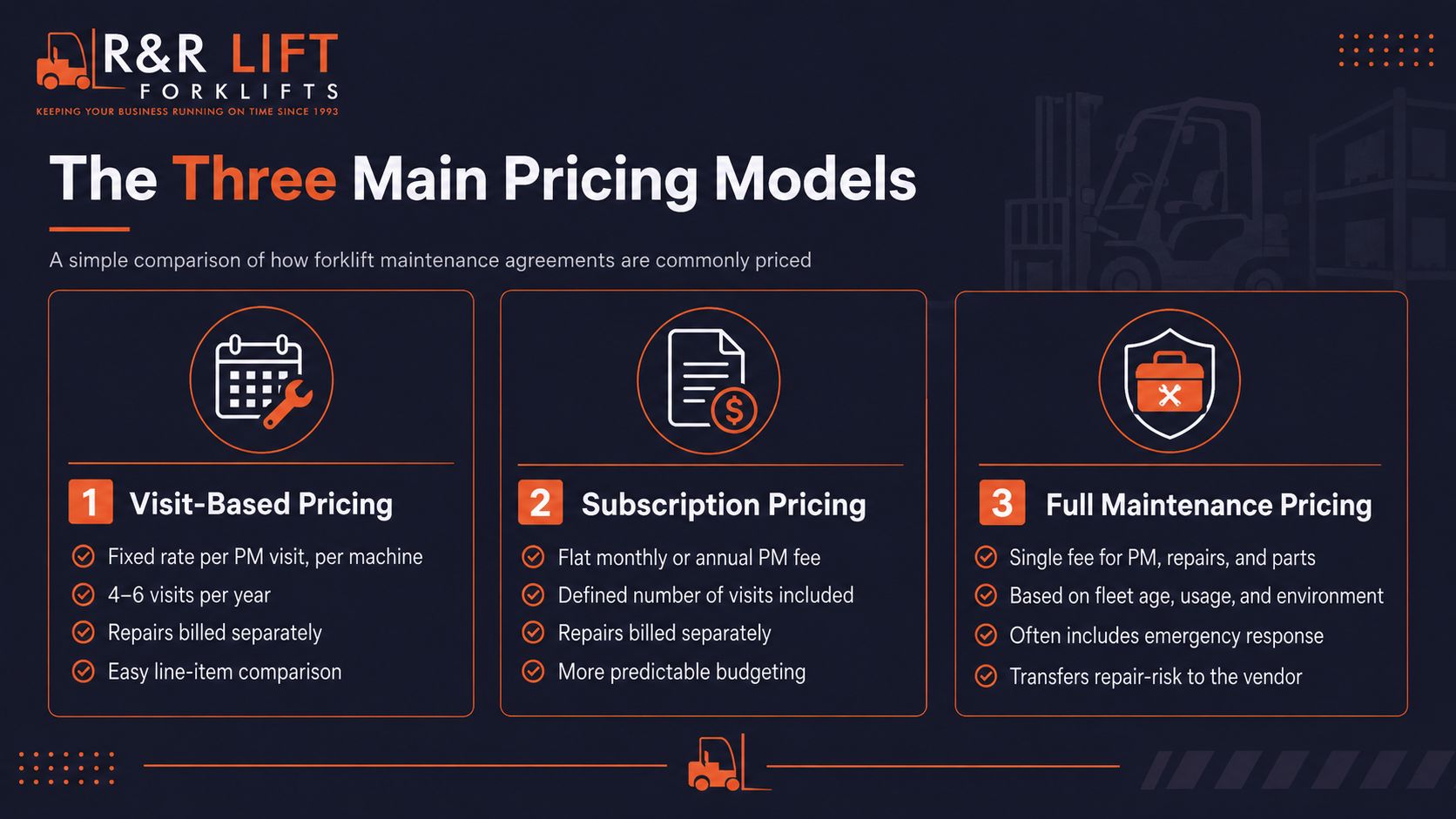
Visit-based pricing for planned maintenance agreements
The simplest pricing model. The vendor charges a fixed rate per PM visit per machine. Total annual cost equals the visit rate multiplied by the number of visits per year per machine multiplied by fleet size, plus any repair work billed separately.
A typical visit-based PM structure for a 10-unit fleet might look like:
- $200 to $500 per machine per visit, depending on machine type and visit scope
- 4 to 6 visits per machine per year, depending on usage intensity
- Total PM-only annual cost: $8,000 to $30,000 for the fleet
- Plus separate billing for any repairs, diagnostic work, or emergency calls between PM visits
Visit-based pricing is straightforward to understand and easy to compare across vendors at the line-item level. The catch: the comparison is only meaningful if the visits being priced are actually equivalent. A $200 thirty-minute PM that hits the surface and a $500 ninety-minute PM that runs a real inspection are different products. Comparing them on price-per-visit hides the operational difference.
Subscription pricing for planned maintenance agreements
Some PM agreements are structured as flat annual or monthly subscriptions per machine, covering a defined number of visits and a defined scope of work. The price is fixed regardless of exactly when visits happen, as long as the vendor delivers the contracted visit count.
A typical subscription PM structure for a 10-unit fleet might look like:
- $1,500 to $3,000 per machine per year for PM coverage
- Total PM-only annual cost: $15,000 to $30,000 for the fleet
- Specific visit count guaranteed in the agreement
- Repair work, parts, and emergency response billed separately
Subscription pricing simplifies budgeting compared to visit-based pricing. It also creates a vendor incentive to compress visit time, because the vendor’s margin improves when each visit takes less labor. That dynamic can work against the buyer if the vendor’s PM scope quality drifts over time without the buyer noticing.
Bundled pricing for full maintenance agreements
Full maintenance agreements bundle PM visits, repairs, parts, and sometimes emergency response into a single fee structure. Pricing is typically a flat per-machine rate, scaled by machine type, age, and usage profile. The vendor takes on the risk of repair frequency variance.
A typical full maintenance pricing structure for a 10-unit fleet might look like:
- $4,000 to $9,000 per machine per year, depending on fleet age, usage intensity, and operating environment
- Total full maintenance annual cost: $40,000 to $90,000 for the fleet
- All PM, routine repair, and parts included under the contract fee
- Often includes emergency response, sometimes with after-hours tier pricing
Full maintenance pricing transfers risk from buyer to vendor for a known fee. That risk transfer is the entire economic logic of the structure. The vendor models expected total cost of keeping the fleet operational, adds margin, and quotes a flat fee. If the fleet runs cleanly, vendor margin is high. If the fleet has unusual repair frequency, vendor margin compresses.
What actually drives pricing variance
Fleet-level variables that affect pricing
Within any of the three pricing models, several fleet-specific factors drive the actual quoted price:
Number of machines: Larger fleets often see modest volume discounts on per-machine pricing because the vendor’s dispatch and travel costs amortize across more units per visit. The discount typically scales with how concentrated the fleet is in a single facility versus spread across multiple sites.
Machine type and complexity: Internal combustion units, LPG, diesel, gasoline, typically cost more per visit than electric units because of fuel system inspection, emissions checks, and the additional moving parts in the powertrain. Within electric, lead-acid battery systems require more PM time than lithium systems. Specialty equipment, rough-terrain, narrow-aisle, specialized attachment platforms, costs more because the inspection scope is broader.
Machine age: Older fleets cost more under any pricing model. Under visit-based pricing, repair frequency rises with age and the buyer absorbs more cost outside the PM agreement. Under full maintenance pricing, the vendor prices age into the contract fee directly. Most vendors won’t quote a flat full maintenance contract on machines older than 10 to 15 years without significant exclusions.
Usage intensity: Multi-shift, high-cycle operations cost meaningfully more to maintain than single-shift, light-cycle operations. The hour-meter ticks faster, PM intervals come up more often, wear accumulates faster, and repair frequency scales accordingly.
Operating environment: Cold storage, dusty manufacturing, outdoor rough-terrain operations, and corrosive industrial environments all increase maintenance costs and pricing. Clean, climate-controlled distribution environments are at the low end of the variance.
Geographic concentration: A fleet split across five facilities in three cities costs more to service per machine than a fleet of the same size in a single facility. Dispatch travel and tech allocation efficiency drive that variance. Some vendors price by facility, others price across the whole fleet.
Vendor-level variables that affect pricing
Beyond your fleet’s specifics, the vendor’s own cost structure and positioning drive significant pricing variance:
Technician cost structure: Vendors with W-2 technicians on full-time wages with benefits cost more to operate than vendors with contractor or hourly technicians. The cost structure shows up in quoted pricing.
Visit duration and scope: A vendor whose PM visits average 90 minutes per machine has higher per-visit labor cost than a vendor whose PM visits average 30 minutes. The price difference reflects the time difference. The catch: more time per visit usually correlates with more thorough inspection, which catches more developing issues at the PM stage, which reduces total cost of ownership over time.
Parts sourcing: Vendors with good OEM relationships and aftermarket parts networks have better parts cost structure than vendors who source ad-hoc. That feeds into both repair pricing and full maintenance pricing.
Risk modeling: Full maintenance pricing depends entirely on the vendor’s ability to model expected repair frequency accurately. Vendors with strong fleet visibility and historical data price more accurately. Vendors without that data price conservatively, higher, to protect against losing money on the contract.
Sales motion overhead: Dealer service pricing absorbs the cost of running a dealer sales operation, including the sales reps who’ll try to sell you new equipment, the showrooms, the OEM relationships, and the broader corporate overhead. Independent service-first vendors don’t have that overhead. The pricing differential isn’t always in the customer’s favor, independents sometimes price higher because they don’t have OEM volume discounts, but the cost structure underneath is genuinely different.
Margin philosophy: Some vendors operate on thin margin and high volume. Others operate on higher margin and more selective client base. Both are valid business models. They produce different pricing.
Dealer pricing vs independent service pricing
How dealer service is structured
Forklift dealers are primarily equipment sales operations. Service is a department inside the larger business, typically running as a support function for equipment sales rather than as the primary revenue engine. That structural fact shapes dealer service pricing in specific ways:
Service ties into the sales motion: Service calls are opportunities to start conversations about replacement equipment, especially on aging machines or after expensive repairs. The technician’s compensation and the service department’s success metrics often have some equipment-sales component built in. Whether that component is large or small varies by dealer.
PM visits are scheduled around dealer capacity: A dealer running a service department also has equipment sales reps, parts operations, used equipment processing, and rental fleet management. Service capacity is allocated against all of those competing demands. PM visit duration tends to compress under capacity pressure because the visit count drives the department’s billable hours.
Parts pricing reflects dealer markup: Dealers buy parts from OEMs at dealer cost and bill at retail or marked-up retail. The markup funds the parts department’s overhead and contributes to dealer margin. For repair-heavy fleets, parts markup is a meaningful portion of total annual cost.
Multi-machine operations get prioritization: Dealers serving large fleet customers allocate technician capacity preferentially to those accounts. If you’re a smaller fleet customer, say 8 to 15 units, at a dealer also serving 100-unit fleet customers, your service priority is going to be lower regardless of contract structure.
How independent service is structured
Independent forklift service firms, companies like R&R Lift, operate without the dealer business model. Service is the primary revenue engine, not a supporting function. The structural differences shape independent pricing:
No new-unit sales motion: Service calls don’t double as sales conversations. Technicians are compensated on service work, not on equipment sales referrals. Recommendations aren’t shaped by quota pressure.
Visit duration is what the work requires: Without the capacity competition that dealer service departments face, independents can structure PM visits at the duration that actually serves the work. Independent vendors who run thorough PM visits typically charge more per visit but spend more time per visit.
Parts pricing varies more: Independents source parts from a wider mix of OEM and aftermarket channels. Pricing on parts can be lower than dealer parts, similar, or sometimes higher depending on the specific component and whether the independent has volume relationships with parts suppliers.
Smaller fleet customers get more attention: A fleet of 12 forklifts is a meaningful account at most independent service firms, where the same fleet at a major dealer might be a low-priority account. Service quality and responsiveness often correlates with how important your account is to the vendor’s business.
The structural differences between dealer and independent pricing don’t always favor one or the other on price. They usually favor different operational outcomes. Dealer pricing often comes with better parts availability and OEM-specific tooling. Independent pricing often comes with better service responsiveness and recommendations that aren’t shaped by sales quotas. The right choice depends on what your operation actually values.
How to evaluate any maintenance agreement quote
The total cost of ownership view
The most common mistake buyers make when evaluating maintenance agreement quotes is comparing them on the wrong line item. A $200 PM visit looks cheaper than a $500 PM visit if you compare the visits directly. But the visits aren’t actually the cost you’re trying to optimize.
The cost you’re trying to optimize is total annual forklift operating cost, which has three components:
- PM agreement cost: What you pay the vendor for scheduled PM visits.
- Reactive repair cost: What you pay for repairs between PM visits, either separately under a PM-only agreement or absorbed by the vendor under a full maintenance agreement.
- Downtime cost: What your operation loses when a forklift is unexpectedly out of service. Most operations lose between $300 and $500 per hour of downtime, sometimes more in production-critical environments.
When you total all three components, the comparison between cheap and thorough PM agreements often inverts. A $200 PM that misses developing issues produces high reactive repair costs and high downtime costs. A $500 PM that catches issues at the inspection stage produces low reactive costs and low downtime costs. The agreement with the higher PM line item typically has the lower total annual cost, often by a meaningful margin for fleets running 10 or more machines.
Questions that surface real pricing differences
When evaluating any quote, the following questions cut through marketing language:
How long does your typical PM visit take per machine?
Manufacturer-recommended PM scopes generally require 60 to 120 minutes for thorough inspection. A vendor running 30-minute PM visits is performing a checklist, not an inspection. The visit price reflects the labor hours. Compare visit duration alongside visit price.
What’s specifically excluded from this agreement?
PM agreements typically exclude repair work, parts, and emergency response. Full maintenance agreements typically exclude major component failures, accident damage, and operator abuse. Read the exclusions carefully. The exclusions list is where the real pricing variance hides.
What’s the parts pricing structure?
For PM-only agreements, ask whether parts are billed at retail, at a markup over dealer cost, or at some defined discount. For full maintenance agreements, ask what counts as “parts included” versus “parts excluded due to component value threshold.”
What’s the contracted emergency response SLA?
A vendor without a contracted SLA on emergency response is reserving the right to deprioritize you whenever something more profitable comes up. Contracted SLAs with response time defined per facility are standard for serious fleet programs.
How is fleet reporting documented and delivered?
Vendors who treat documentation as standard deliver it monthly without requiring you to ask. Vendors who treat documentation as optional charge for it or produce it inconsistently. The documentation question often distinguishes vendors at similar price points.
Are repair labor rates discounted under the agreement?
For PM-only agreements that bill repair labor separately, ask whether agreement clients get reduced labor rates. Some vendors offer 10 to 20 percent off retail labor as a contract benefit. Others don’t. The answer matters more for fleets with significant repair volume.
What “expensive” actually means
A $500 PM is not expensive if it prevents $5,000 in reactive repair costs and downtime. A $200 PM is not cheap if the cost of the missed maintenance shows up later as $8,000 in emergency repair work. The terms “cheap” and “expensive” only mean something in the context of total annual cost.
For most fleets running 10 or more units, the right benchmark for “expensive” is whether the agreement produces a higher total annual operating cost than the alternatives. A thorough PM-only agreement often produces a lower total cost than a cheap PM-only agreement. A well-priced full maintenance agreement often produces a lower total cost than a fragmented PM-plus-repair structure with multiple vendors. Run the math on your specific fleet before deciding which agreement structure is “expensive” for you.
We built a calculator that runs this math against your actual fleet numbers. It models PM cost, reactive repair cost, and downtime cost together, and shows the total annual cost picture under different maintenance scenarios. If you want to see what the total cost view looks like for your operation specifically, that’s the fastest path.
How R&R structures program pricing
Pricing against downtime cost, not visit volume
The way we structure fleet program pricing reflects the math above. We price programs against the downtime cost the program prevents, not against the per-visit hourly rate of individual repairs. That structural decision changes the conversation in two ways.
First, it forces the conversation to focus on total annual cost rather than per-visit pricing. When a prospect tells us “your dealer’s PM is $200 and yours is $500,” our response is to walk through the three-line cost view, PM cost, reactive cost, downtime cost, and ask which agreement actually produces the lower total annual cost for their specific fleet. The answer is usually our program, but sometimes the answer is “your current setup is fine, don’t switch.”
Second, it lets us be honest about cases where a fleet program isn’t the right fit. Operations with very small fleets, very light usage, or strong internal maintenance capability sometimes don’t benefit from a program structure. We tell those operations directly. The trust earned from that honesty is worth more in the long run than the contract revenue we’d get from selling a program that doesn’t serve the operation.
How we model program pricing
Three factors drive our program pricing for any specific fleet:
Fleet composition: Number of machines, machine types, machine age, and operating environment. We document every machine on the initial site walk and use that inventory as the basis for program structure.
Usage profile: Shifts per day, average hours per week per machine, operational intensity. These determine how often PM visits are scheduled and what the realistic repair frequency looks like.
Service requirements: What the operation actually needs from the program. Some fleets need standard PM coverage with on-call repair. Some need full maintenance with documentation depth. Some need specialized capabilities like cold-environment service or production-line coordination. Pricing reflects the actual scope of service.
We don’t publish a standard rate sheet because fleet programs don’t translate cleanly into one. A 12-unit LPG fleet running two shifts in a dusty manufacturing environment is a different program than a 15-unit electric fleet in a clean DC running single-shift. The proposal we send back after a site walk reflects the specific operation, not a templated price.
What we commit up front: pricing is structured to clearly favor the program over your current reactive spend on a total cost basis. If the math doesn’t work out that way for your specific fleet, we’ll tell you that directly.
The right price for a maintenance agreement isn’t the lowest one.
Forklift maintenance agreement pricing varies for real reasons. Visit duration, technician cost structure, parts sourcing, risk transfer, dealer overhead. None of those variables are random, and most of them have direct operational consequences. The agreement that’s “cheap” at the line-item level often isn’t cheap when you total the line items.
If you’re evaluating maintenance agreement quotes for your Central Texas fleet, the most useful exercise is running the total cost view on your actual numbers. We’d be happy to walk through that math with you, either through the downtime calculator or in a no-cost site walk where we look at your fleet directly.