When a fleet ops manager is told to reduce forklift maintenance costs, the obvious move is to cut the maintenance line item: less frequent PM, cheaper vendor, defer non urgent repairs. It feels like cost reduction. In practice, it usually isn’t. Cutting maintenance spend often increases total cost, because the reduction in the maintenance line gets more than offset by the increase in reactive repairs and downtime that the cut maintenance was preventing.
Real maintenance cost reduction means reducing the total cost of operating your fleet, not just the line item labeled “maintenance.” Those are different numbers, and optimizing the wrong one is how operations end up spending more while believing they’re saving.
This guide covers five concrete strategies to reduce forklift fleet maintenance costs without compromising uptime. Each one reduces total cost of ownership rather than just shifting cost from one budget line to another. We’re a forklift fleet service specialist, so we have a perspective on this, but the strategies below work regardless of who your vendor is.
Understand what you’re actually trying to reduce
The three cost lines
Before reducing costs, understand which cost you’re reducing. Operating a forklift fleet has three cost components:
- PM cost: what you spend on scheduled preventative maintenance
- Reactive repair cost: what you spend fixing things that break between PM visits
- Downtime cost: what your operation loses when a machine is unexpectedly out of service
The naive approach to cost reduction targets line 1, because it’s the most visible and the easiest to cut. But cutting line 1 typically increases lines 2 and 3. The thorough PM you cut was catching issues before they became reactive repairs and downtime. Remove it, and those issues surface as breakdowns instead.
The sophisticated approach targets the total of all three lines. Sometimes that means spending more on line 1 (better PM) to reduce lines 2 and 3 by more than the increase. Sometimes it means other strategies entirely. But it always starts with optimizing the total, not the most visible line.
Why the visible line is the wrong target
The reason maintenance cost reduction goes wrong so often is that line 1 (PM cost) shows up clearly on invoices, while lines 2 and 3 are scattered and partly invisible. Reactive repair costs show up as individual repair invoices that don’t get totaled. Downtime costs don’t show up on any invoice at all. They’re distributed across missed production, idle labor, and operational disruption.
So when a manager cuts PM to save money, the savings on line 1 are immediately visible, while the increased costs on lines 2 and 3 are diffuse and delayed. The cut looks successful in the short term and the offsetting cost increase shows up later, disconnected from the decision that caused it. This is the central trap in forklift maintenance cost reduction.
The five strategies
Strategy 1: Improve PM execution quality (counterintuitively)
The first strategy for reducing total maintenance cost is often spending more on PM, not less, specifically by improving PM execution quality.
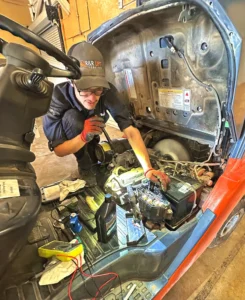
A thorough PM that runs 90 to 120 minutes per machine catches developing issues at the inspection stage. Catching a worn hydraulic line during a PM and replacing it on the spot costs a fraction of what it costs after that line fails mid shift, causing an emergency repair plus downtime. The thorough PM costs more per visit but reduces reactive repair and downtime costs by more than the increase.
The trade, in operating terms: take a 10 unit fleet moving from a thin PM (catching few issues) to a thorough PM (catching most issues at inspection). Each visit takes longer and the PM line goes up. But every issue caught on the stand is a breakdown that doesn’t happen on the floor. That means fewer emergency calls, fewer units sitting down during a shift, and fewer hours your operators stand idle waiting on a repair. The hours of lost production avoided are often several times the added PM spend.
This is the counterintuitive core of maintenance cost reduction: the path to lower total cost often runs through higher PM quality, not lower PM spend.
Strategy 2: Right size the fleet
Many operations run more forklifts than they need, or the wrong mix of forklifts for their actual work. Every machine in the fleet carries maintenance cost whether it’s fully utilized or not.
A fleet right sizing analysis looks at actual utilization across the fleet. Which machines run constantly? Which sit idle most of the time? Could the work be done with fewer machines, or with a different mix of machine types better matched to the actual tasks? Reducing fleet size where utilization is low directly reduces maintenance cost, because you’re maintaining fewer machines.
This isn’t always possible (some operations need peak capacity even if average utilization is lower), but many operations carry one or two machines more than they need out of habit. Each machine eliminated removes its full annual maintenance cost from the total.
Strategy 3: Optimize lifecycle timing
Operations lose money at both ends of the lifecycle curve: running machines past the point where maintenance is economical, and replacing machines before they’ve delivered their full value.
Running a machine past its economical life means pouring repair money into a unit that should be retired. The repair costs climb, the downtime frequency rises, and the total cost of keeping the machine exceeds what replacement would cost. Optimizing lifecycle timing means identifying these machines and replacing them at the right time, which reduces the disproportionate maintenance cost they generate.
The reverse error (replacing too early) wastes capital but doesn’t show up in maintenance cost. So the maintenance cost reduction angle on lifecycle is specifically about identifying and retiring the money pit machines that are dragging up the fleet’s total maintenance spend.
Strategy 4: Consolidate vendor relationships
Operations that use multiple service vendors, or a patchwork of dealer service and independent service and in house work, often pay more in total than operations with a consolidated relationship.
Fragmented vendor relationships create inefficiency: no single vendor knows the whole fleet, institutional knowledge is split, diagnostics start from scratch with each vendor, and buying power is diluted across multiple relationships. Consolidating to a single vendor who knows the entire fleet typically reduces cost through better diagnostics (faster resolution because the vendor knows the equipment), volume pricing efficiency, and the elimination of the coordination overhead of managing multiple relationships.
The consolidation savings are real but often overlooked because they’re indirect. They show up as faster repairs, fewer repeat issues, and better pricing, rather than as an obvious line item reduction.
Strategy 5: Invest in operator practices
A meaningful portion of forklift maintenance cost comes from operator driven wear and damage: hitting racks, overloading, improper operation, skipping pre shift inspections that would catch issues early. Operations with strong operator training and accountability practices have lower maintenance costs than operations without.
The pre shift inspection in particular is a free maintenance tool that’s often underused. Operators who actually perform thorough pre shift inspections catch issues early (low fluid, developing leaks, brake problems) before they cause failures. The inspection takes a few minutes per shift and prevents failures that cost far more.
Investing in operator practices (training, accountability, inspection discipline) reduces the operator driven portion of maintenance cost, which can be a surprising fraction of the total in operations where it’s been neglected.
What not to do
The cost reduction moves that backfire
A few common cost reduction moves that increase total cost despite appearing to save:
Cutting PM frequency or quality. Covered above. The single most common cost reduction move that backfires. The PM savings get more than offset by reactive repair and downtime increases.
Switching to the cheapest vendor on PM price alone. A cheap vendor whose PM is thin produces the same backfire as cutting PM. The low PM price is offset by higher reactive and downtime costs. Vendor selection should be on total cost, not PM price.
Deferring non urgent repairs. Deferring a flagged repair to save money in the current period often means the issue worsens into a more expensive repair, or fails entirely and causes downtime. Most flagged repairs are cheaper to address when flagged than after they progress.
Stretching consumables past their service life. Running tires, batteries, filters, and other consumables past their replacement point to save on supply cost usually causes downstream damage that exceeds the savings.
The pattern across all of these: they reduce a visible cost in the current period while increasing diffuse or delayed costs that exceed the savings. They optimize the wrong number.
How to actually measure cost reduction
Track total cost, not line items
To know whether a cost reduction effort is actually working, you have to track total cost of ownership, not just the maintenance line item. That means tracking:
- PM cost (visible, easy)
- Reactive repair cost (requires totaling individual repair invoices)
- Downtime cost (requires estimating incident frequency, duration, and the hours your operators and loads sat waiting)
The total of these three is the number to reduce. An effort that reduces PM cost while increasing the total is not cost reduction. An effort that increases PM cost while reducing the total is.
The baseline problem
Most operations can’t measure whether their cost reduction efforts work because they don’t have a baseline. They know their PM cost (it’s on invoices) but not their reactive repair total (scattered across invoices) or their downtime cost (not on any invoice).
Establishing a baseline is the prerequisite for measuring cost reduction. Pull the last 12 months of repair invoices and total them. Count downtime incidents and the hours each one kept a unit down. Add these to the PM cost for a total cost baseline. Then any cost reduction effort can be measured against the right number.
We built a calculator that models this three line total cost against your fleet inputs, which is a fast way to establish the baseline and see where your costs actually sit. The exercise of establishing the baseline often reveals that the maintenance line everyone focuses on is the smaller part of the total.
How R&R approaches cost reduction
Total cost, transparently
When we structure a fleet program, we price it against the downtime it prevents, not against the hourly rate of individual repairs. The conversation is explicitly about total cost of ownership: PM cost plus reactive repair cost plus downtime cost, before and after a program.
For operations coming from thin PM or reactive maintenance, a thorough program usually reduces total cost even though it raises the PM line. For operations already running good maintenance, the savings might be modest or absent, and we’ll tell you that directly rather than manufacturing a savings number.
The honest version
The honest version of maintenance cost reduction is that it’s not always available. Some operations are already running close to optimal, and there’s no meaningful cost to cut without compromising uptime. For those operations, the right answer is “your costs are reasonable, don’t change anything,” not a manufactured savings pitch.
For the many operations running thin PM, fragmented vendors, unoptimized lifecycles, or neglected operator practices, real cost reduction is available, often substantial. The five strategies above are where it comes from. Which ones apply depends on your specific situation.
Real cost reduction lowers the total, not just the visible line.
The instinct to cut the maintenance line item is the most common and most counterproductive approach to reducing forklift fleet costs. Real cost reduction comes from lowering total cost of ownership: better PM execution, right sized fleets, optimized lifecycle timing, consolidated vendors, and stronger operator practices. Each of those reduces the total even when some of them raise the maintenance line.
If you want to understand where your fleet’s total cost actually sits and where real reduction is available, that’s what a no cost site walk with us provides. We’ll establish your baseline, identify which of the five strategies apply to your operation, and tell you honestly how much is actually available to save. Call 512-256-5312 or use the form at /contact/.