
Most fleet operations have been burned at least once by a forklift maintenance vendor. Promised response times that didn’t materialize. PM visits that got shorter every quarter. Repair quotes that mysteriously expanded once the technician was on site. Service teams that rotated so often nobody knew the fleet by the third call.
Thank you for reading this post, don't forget to subscribe!The patterns that produce those experiences usually show up in the maintenance agreement itself, before the vendor ever shows up to do work. If you know what to look for, you can spot them in the proposal, the contract, or the first sales conversation.
This guide covers nine specific red flags in forklift maintenance agreements, what each one actually means operationally, and how to verify whether the vendor you’re evaluating is structured to avoid them. If you’re sitting on multiple maintenance agreement quotes and trying to decide which vendor to sign, this piece will help you cut through the marketing language to what’s actually being offered.
Red flags in the agreement itself
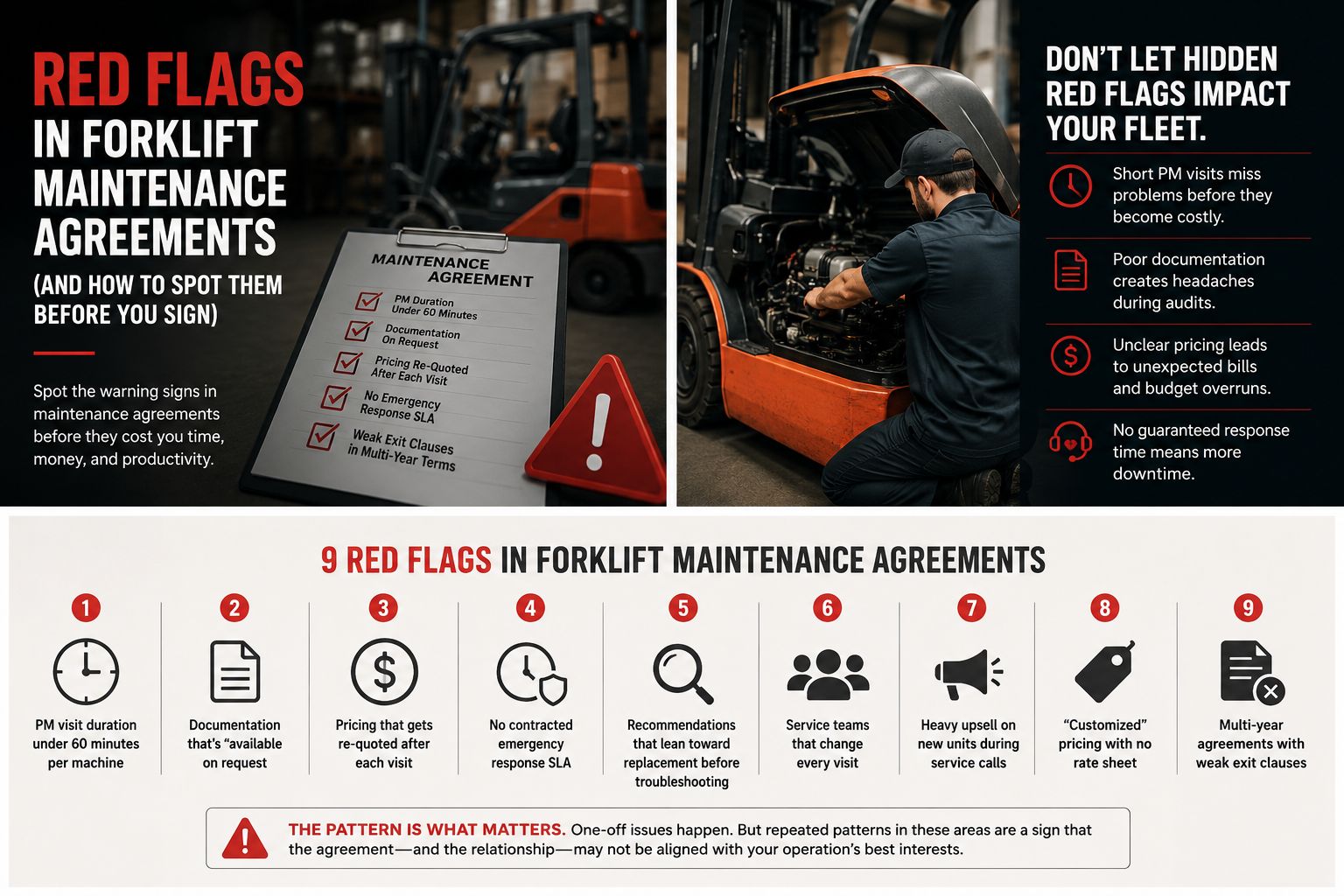
Red flag 1 – PM visit duration under 60 minutes per machine
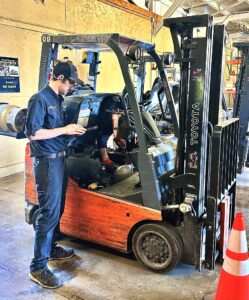
The most important single signal in any forklift maintenance agreement is how long the PM visit actually takes. Manufacturer-recommended PM scopes generally require 60 to 120 minutes per machine for a thorough inspection, depending on machine type, age, and operating environment. A vendor running 30-minute PM visits is performing a checklist, not an inspection.
Why it matters: Short PM visits don’t catch developing issues. The technician hits the obvious checkboxes (fluid levels, filter changes, surface inspection) and moves on. The hairline crack in a mast chain, the hydraulic line starting to weep, the brake pad wearing unevenly. None of those get caught at 30 minutes per machine. They get caught at 90 minutes, which is why thorough PM costs more and takes longer.
How to verify: Ask the vendor directly: how long does your typical PM visit take per machine? If the answer is under 60 minutes, the visit is performative. If the answer is “it depends” with no concrete range, push for specifics. A vendor who can’t tell you the typical duration is either dodging the question or doesn’t track it. Either is a problem.
Red flag 2 – Documentation that’s “available on request”
Maintenance documentation should be a standard deliverable, not an option. Service records per machine, monthly fleet reports, OSHA inspection documentation, parts replacement logs. All of these should be produced as part of the regular service workflow and delivered without you having to ask.
Why it matters: A vendor who treats documentation as optional treats it as overhead, not as part of the service. When you actually need that documentation for an audit, an insurance review, or an internal compliance check, you’ll be chasing it. Vendors who haven’t built documentation into their workflow can’t produce it on short notice without the records being incomplete or reconstructed after the fact.
How to verify: Ask the vendor to show you a sample of the service documentation you’d receive. Not a description of it. An actual sample. If they can produce a real, redacted client report with machine-level detail and clear formatting, the documentation is real. If they describe it vaguely or say “we’ll put something together,” documentation isn’t part of the standard product.
Red flag 3 – Pricing that gets re-quoted after each visit
A maintenance agreement should define pricing in advance for the scope it covers. PM visits should be priced by visit, by machine, or by subscription. Repair labor should be priced at defined hourly rates. Parts pricing should follow defined structure (retail, markup over dealer cost, or a specified discount).
Why it matters: Vendors who re-quote pricing after each visit have margin opportunism built into the structure. Each visit becomes a new pricing negotiation, with the vendor’s margin floating based on what they can charge in the moment. Over a multi-year relationship, that pattern produces meaningful price drift in the vendor’s favor without any obvious billing irregularity.
How to verify: Read the agreement carefully. Look for defined rate structures: “PM visits at $X per machine per visit,” “repair labor at $Y per hour,” “parts at retail less Z percent.” If the agreement says “pricing as quoted on each visit” or similar language, the agreement isn’t actually committing to a price structure.
Red flag 4 – No contracted emergency response SLA
Emergency response time should be written into the contract with specific commitments. “Same-day response during business hours, next-business-day for after-hours calls” is a real SLA. “We’ll respond as fast as we can” is not.
Why it matters: A vendor without contracted SLAs is reserving the right to deprioritize you whenever something more profitable comes up. When you have a forklift down at peak shift and the vendor has another customer with a more urgent issue (or a more profitable one), your call goes to the back of the queue. With a contracted SLA, the vendor has committed to a response time regardless of what else is happening in their dispatch operation.
How to verify: Look in the contract for explicit response time commitments by service type and by time of day. If the language is vague or aspirational (“typically within…,” “we strive to…”), push the vendor for specific contracted commitments. If they refuse to commit, the SLA you’ll actually get is whatever they feel like delivering.
Red flags in vendor behavior
Red flag 5 – Recommendations that lean toward replacement before troubleshooting
A technician’s first response to a fault code or a performance issue should be diagnostic work, not a replacement recommendation. Sometimes the right answer is replacement. Often it isn’t. The order of operations matters.
Why it matters: Vendors whose first response is “you should consider replacing this machine” before any meaningful diagnostic work are operating on a sales motivation, not a service motivation. This pattern shows up most strongly with dealer service departments where new-equipment sales is part of the broader business. The technician isn’t necessarily acting in bad faith. The compensation structure and dealer culture push toward sales conversations during service calls, especially on aging machines.
How to verify: Watch the pattern over the first few service calls with any new vendor. If recommendations consistently steer toward replacement before troubleshooting (or before exhausting reasonable repair options), the vendor’s incentives aren’t aligned with your operational interests. Independent service vendors who don’t sell new equipment can’t have this pattern in the same way, because they don’t benefit from selling you a new unit.
Red flag 6 – Service teams that change every visit
The technician who shows up at your facility should not be a different person every visit. Institutional knowledge of your fleet, your operators, your facility, and your equipment history is part of what you’re paying for under any maintenance agreement.
Why it matters: When the technician changes every visit, every service call starts from scratch. The diagnostic process loses the context of what was found last visit. The repair quality drifts as different techs apply different judgment to similar issues. Operators have to re-explain their concerns each time. The vendor’s account team, if they have one at all, fragments across whoever’s on shift.
How to verify: Ask the vendor how the service team is structured. A small team of dedicated technicians who rotate through your account specifically is a good answer. A pool of 60+ technicians with assignments based on availability is a worse answer. Either is workable, but the second pattern requires significantly stronger vendor processes to compensate for the lack of continuity, and most vendors don’t have those processes.
Red flag 7 – Heavy upsell on new units during service calls
Closely related to Red flag 5, but worth calling out separately. If service calls consistently turn into sales conversations about new equipment, the vendor’s compensation structure is built around equipment sales, and the service is a vehicle for that.
Why it matters: Service-first vendors have technicians whose compensation is tied to service work. They have no structural reason to introduce sales conversations during service calls. Dealer service departments have technicians whose compensation often has some equipment-sales referral component, even if it’s small. That structural fact distorts the service interaction. Recommendations get filtered through “is there a sales opportunity here,” even unconsciously.
How to verify: Track the pattern across multiple service calls with any vendor. If sales conversations consistently surface during service work, the vendor’s incentives don’t fully align with yours. Independent service-first firms don’t have this pattern in the same way because their technicians don’t have new-unit referral comp.
Red flags in the relationship structure
Red flag 8 – “Customized” pricing with no rate sheet
Some vendors avoid publishing standard rates because they want flexibility to price each customer based on perceived willingness to pay. That practice produces wide pricing variance across similar customers and creates margin opportunism that customers usually don’t see.
This is a nuanced red flag because there are legitimate reasons not to publish rate sheets. Fleet maintenance pricing genuinely depends on fleet size, machine type, age, and usage profile. The right pricing for a 12-unit LPG fleet in a manufacturing environment is different from the right pricing for a 15-unit electric fleet in a clean DC. Publishing a single rate sheet would oversimplify.
Why it matters: The legitimate reason for custom pricing is to match the actual operational scope. The illegitimate reason is to maximize what each customer can be charged. Both look the same from the outside.
How to verify: Ask the vendor to walk you through how they arrive at pricing. A vendor with a defensible methodology can explain their pricing logic: visit duration assumptions, repair frequency models, parts cost structures, risk modeling for full maintenance contracts. A vendor without that explanation is pricing intuitively, which is another way of saying they’re charging what they think they can get.
Red flag 9 – Multi-year agreements with weak exit clauses
Maintenance agreements typically run one to three years with auto-renewal terms. The exit clauses determine how easily you can leave if the vendor’s performance disappoints.
Strong exit clauses include: termination for material breach with defined breach criteria, termination for convenience with reasonable notice (60 to 90 days), and clear pro-ration of fees on early termination. Weak exit clauses include: termination only for cause with vague cause definitions, multi-month notice requirements, early termination fees that exceed reasonable damages, and auto-renewal language that locks you into another full term if you miss a narrow notice window.
Why it matters: A vendor confident in their ability to deliver service quality doesn’t need restrictive exit clauses. A vendor who relies on contract structure to retain customers is signaling that their service quality might not retain customers on its own. Multi-year agreements with weak exit clauses are a way of locking customers into relationships that wouldn’t otherwise hold up.
How to verify: Read the termination section of the agreement carefully. Look for the conditions under which you can leave, the notice requirements, the early termination fees, and the auto-renewal language. If anything in this section feels unreasonable, push the vendor for amendment. If they refuse, that itself is a useful signal.
How to use this checklist

Running the check on your current vendor
If you’re already in a maintenance agreement and aren’t sure whether it’s serving you well, the nine red flags above are a useful self-audit. Pull your current agreement, your last six months of service records, and your billing history. Walk through the checklist:
- How long have your last six PM visits actually taken per machine?
- What documentation have you received, and how often?
- Has pricing held steady, or has it drifted?
- Has emergency response been consistent, and does the contract commit to anything specific?
- Have replacement recommendations come up disproportionately compared to repair recommendations?
- Has the service team been the same, or has it rotated?
- Has anyone tried to sell you new equipment during service work?
- How does your current vendor’s pricing compare to other quotes you’ve gotten?
- What are your exit options if you wanted to leave?
If most answers come back clean, your current vendor is structurally fine, and any frustration you have with them is probably about specific incidents rather than systemic patterns. If most answers come back as red flags, the relationship probably isn’t serving your operation, regardless of how long you’ve been with the vendor.
Running the check on prospective vendors
If you’re evaluating new vendors, walk through the same checklist with each one before signing. Ask the questions directly. Read the agreements carefully. Compare the answers across vendors at similar pricing.
Most vendors will fail at least one or two of the checks. That’s normal. The question is whether the fails are minor (a vendor that doesn’t publish rate sheets but explains pricing methodology clearly) or systemic (a vendor that fails on PM duration, documentation, SLA, and pricing transparency simultaneously).
A vendor failing three or more checks is not a vendor you want to sign with, regardless of how good the headline pricing looks. The structural issues will surface in the operational reality of the relationship.
What to look for in a vendor that passes
A vendor structured to avoid these red flags typically has a few visible markers:
- PM visit duration of 60 to 120 minutes per machine, defined and documented.
- Standard documentation as a deliverable, with samples available on request.
- Defined rate structures for PM, repair labor, and parts in the agreement.
- Contracted emergency response SLAs with specific time commitments.
- Diagnostic-first culture in service interactions.
- Small teams of dedicated technicians rotating through specific accounts.
- Service-first business model rather than dealer-with-service-department model.
- Defensible pricing methodology you can ask about and get a real answer on.
- Reasonable exit clauses in multi-year agreements.
No single vendor will be perfect across all nine. The pattern of how they handle the checklist tells you what kind of vendor relationship you’re actually entering.
Where R&R fits
Our perspective, briefly
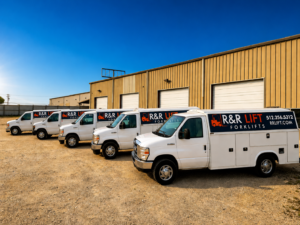
R&R Lift is a forklift fleet service specialist serving Central Texas since 1993. We’re not a dealer with a service department. The structural facts of how we operate align with most of the red flag avoidance patterns above:
- PM visits run 90 to 120 minutes per machine.
- Documentation is standard, including consolidated monthly fleet reports for program clients.
- Pricing is defined in agreements with specific rate structures.
- Emergency response SLAs are written into program contracts: same-day response during business hours, next-business-day for after-hours calls.
- Service team is small and dedicated, with the same technicians rotating through accounts.
- Service is the entire business, not a department supporting equipment sales.
We don’t claim to be perfect on every dimension. Our pricing on individual repair work is sometimes higher than dealer pricing because we don’t have the OEM volume discounts dealers get on parts. Our after-hours coverage depends on technician availability and is billed at 1.5 times standard labor rates. Our service area is concentrated in Central Texas, so multi-state operations need a different vendor structure.
What we do commit to is that the structural red flags above don’t apply to us. If you’re evaluating us alongside other vendors, run the checklist. We’d rather you do the diligence and choose us with eyes open than sign with us based on marketing language and discover the pattern later.
The pattern is what matters.
Every red flag in this guide describes a pattern, not a one-time incident. Vendors have bad days. Technicians get sick. Parts shortages happen. The question isn’t whether any single thing has gone wrong. The question is whether the structural patterns of the relationship are working in your operation’s favor or against it.
If you’re evaluating maintenance agreement quotes for your Central Texas fleet, walk through this checklist with each vendor. We’d be happy to walk through it with you on our own program if that’s useful, or to benchmark our program against your current setup. No commitment, no pressure.