If you’re running a forklift fleet of any meaningful size in Central Texas, you’ve probably been pitched on a maintenance agreement. Two main agreement types dominate the industry: planned maintenance and full maintenance. The difference between them isn’t subtle, and the choice between them isn’t obvious. The wrong choice can cost a fleet operation tens of thousands of dollars a year in either direction.
Thank you for reading this post, don't forget to subscribe!This guide is a practical breakdown of how planned and full maintenance agreements actually work, how each is priced, when each makes sense, and the dimension that almost every comparison guide ignores: the quality of execution under either agreement type, which usually matters more than the agreement type itself.
We’re a forklift fleet service specialist based in Central Texas, so we have a perspective on this. We’ll be straight about where that perspective comes from. By the end of this guide you should be able to evaluate any maintenance agreement you’re offered, including ones from us, and tell whether it’s a good deal for your operation.
What planned maintenance actually is
Planned maintenance, defined
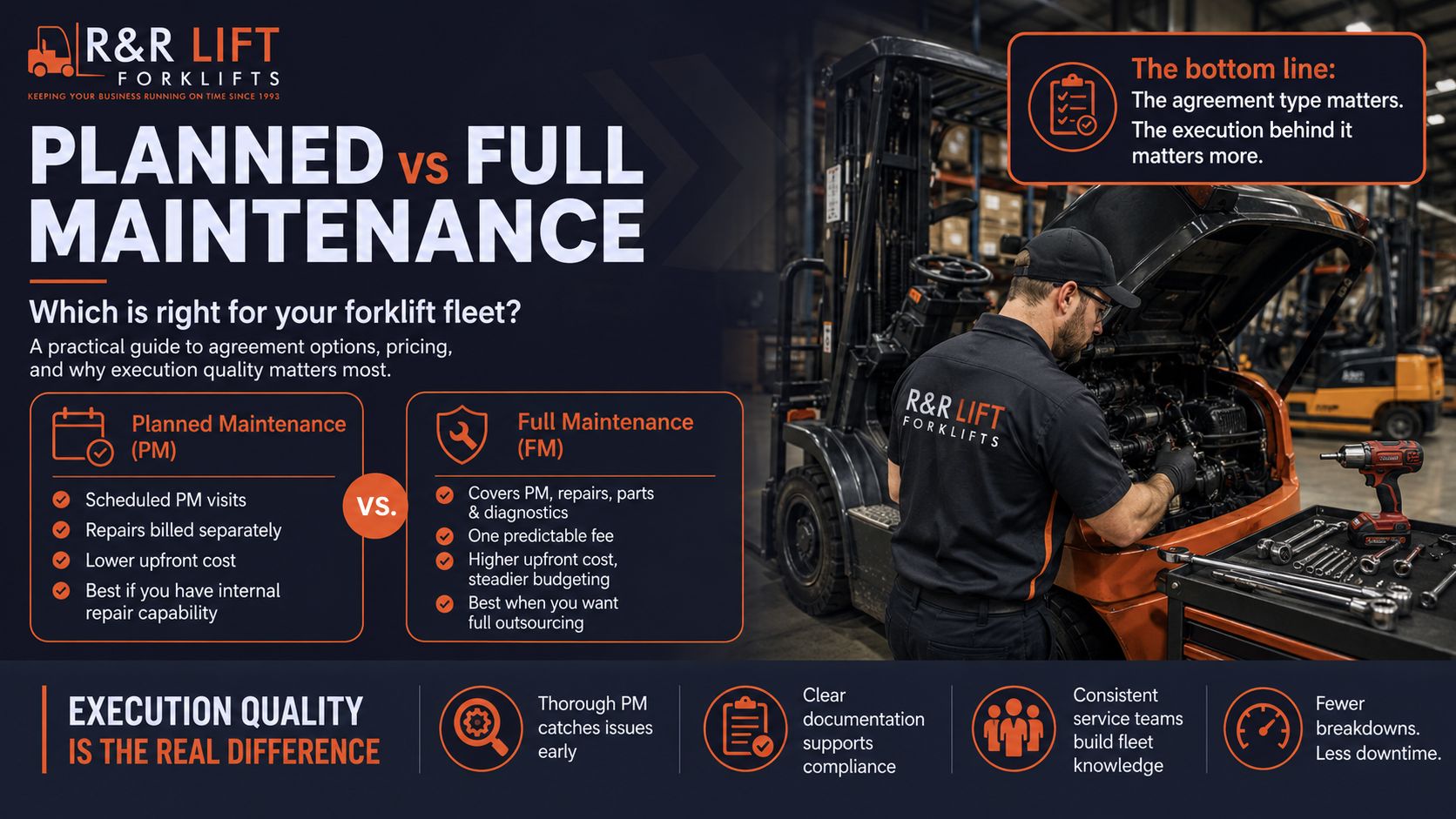
A planned maintenance agreement, often called a PM agreement in the industry, is a service contract where the vendor commits to scheduled preventative maintenance visits at agreed intervals. The PM agreement itself covers only the planned visits. Anything that happens between PM visits, including diagnostic work, repairs, and emergency response, is billed separately at agreed labor rates and parts costs.
A typical PM agreement structure:
- The vendor inspects each machine in your fleet at a defined cadence, usually based on hour-meter intervals (200, 1,000, and 2,000 hours are the most common manufacturer-recommended thresholds). Some PM agreements are calendar-based instead, with monthly or quarterly visits that don’t account for actual usage.
- Each PM visit covers a specified scope of work: fluid levels, filters, visible wear items, basic operational checks, and a brief inspection report. Some PM agreements include more thorough diagnostic-style inspection. Most don’t.
- The PM fee is fixed per visit, per machine, per year, or some combination of those.
- Repair work, parts replacement, hydraulic work, mast and chain repairs, and any non-PM service is billed separately at the vendor’s standard rates.
The critical thing to understand about a PM agreement is that the PM visits are the entire scope of the agreement. The vendor is not committing to keep your fleet running. They’re committing to perform a specific service activity at a specific frequency. Whether that activity actually prevents failures depends entirely on what gets inspected during the visit and how thorough the technician is.
What’s typically included in a PM visit
The standard scope of a planned maintenance visit usually covers the following:
- Fluid level checks: Engine oil, hydraulic fluid, transmission fluid, brake fluid, coolant. Top off as needed.
- Filter replacement: Engine air filter, oil filter, hydraulic filter, fuel filter on internal combustion units.
- Visual inspection: Tires, mast chains, forks, hoses, belts, and other visible wear components.
- Basic operational test: Lift, lower, tilt, drive forward, drive reverse, brake function, horn, lights.
- Battery check: Electric units. Specific gravity, water levels, terminal condition, charger function.
- Fuel system check: LPG and diesel units. Connections, leak inspection, regulator function.
- Service report: A summary of work performed, findings, and any flagged issues.
The variance in PM scope across vendors is enormous. Some vendors run a thorough 90 to 120 minute inspection that catches developing issues before they become failures. Others run a 30 to 45 minute checklist that hits the surface and moves on. Both are technically planned maintenance. Both might be billed under similar PM agreement structures. Neither produces the same operational outcome.
How PM agreements are priced
PM agreement pricing depends on three factors: fleet size, machine type and complexity, and visit frequency. Standard pricing models include:
- Per-visit pricing: A fixed rate per machine per PM visit, multiplied by the number of visits per year.
- Annual subscription: A flat annual fee per machine that covers a defined number of PM visits.
- Bundled pricing: A single fleet-level annual fee that covers all PM visits across all machines, sometimes with tiered pricing based on fleet size.
Repair work, parts, and service calls outside the PM scope are billed at the vendor’s standard rates, often with a service call dispatch fee plus hourly labor and parts at retail or marked-up cost. Some PM agreements include modest discounts on repair labor or parts as part of being a contracted client. Others don’t.
The pricing variable that matters most is what the vendor actually charges for the PM visit itself, and what’s included in that price. A $200 PM visit that takes 30 minutes is fundamentally a different product than a $500 PM visit that takes 90 minutes, even though both are technically PMs.
What full maintenance actually is
Full maintenance, defined
A full maintenance agreement, often called an FM agreement or a complete care agreement, is a service contract where the vendor commits to keeping your fleet operational. The FM agreement covers planned maintenance, repairs, parts, diagnostics, and depending on contract structure, emergency response, all under a single fixed-fee structure.
A typical FM agreement structure:
- The vendor inspects each machine at planned intervals as part of the agreement.
- All routine repairs, diagnostic work, parts replacement, and standard service work is included in the contract fee at no additional charge.
- Some FM agreements include emergency response. Others charge extra for after-hours or off-schedule emergency calls.
- The contract fee is usually a flat monthly or annual amount per machine, with adjustments based on machine type, age, and usage intensity.
- Catastrophic failures, accident damage, operator abuse, and major component replacements, engine rebuilds, transmission failures, mast replacement, are typically excluded or covered with a deductible.
The critical thing to understand about an FM agreement is that the vendor takes on the risk of frequent repairs. If your fleet has reliability problems, the vendor absorbs that cost under the contract. If your fleet runs cleanly, the vendor’s margin is higher. That risk transfer is what FM agreements are really selling.
What’s typically included in an FM agreement
Standard FM agreement scope usually includes:
- All scheduled PM visits at defined intervals.
- All routine repairs and parts replacement under defined limits.
- All diagnostic work for fault codes and performance issues.
- Hydraulic, electrical, brake, and mechanical repair work.
- Wear-item replacement, tires, batteries, forks, under specific terms.
- Service reports and basic documentation.
Common exclusions include:
- Catastrophic component failures over a defined dollar threshold.
- Accident damage or operator abuse.
- Major upgrades or modifications.
- Equipment retrofits or attachment changes.
- Emergency response outside business hours, sometimes included, sometimes extra.
How FM agreements are priced
FM agreement pricing is fundamentally about risk transfer, so it’s priced based on the vendor’s expected total cost of keeping your fleet operational, plus margin. The vendor models expected PM costs, expected repair frequency, expected parts consumption, and expected service hours per machine, then adds margin and quotes a flat fee.
Pricing variables include:
- Fleet age and condition: Older, more worn fleets cost more to keep running, so FM pricing is higher.
- Usage intensity: Multi-shift, high-cycle operations cost more to maintain, so FM pricing is higher.
- Machine type: Electric units in clean environments are cheaper to maintain than internal combustion units in dusty manufacturing environments.
- Operating environment: Cold storage, dusty manufacturing, rough-terrain outdoor operations all increase maintenance costs and FM pricing.
- Fleet size: Larger fleets often get volume pricing, but the per-machine fee scales with fleet age and usage profile.
A typical FM agreement might price between two and four times the per-machine cost of a PM-only agreement, depending on the variables above. The math the vendor is doing: if expected annual repair cost on a machine is $X, and PM cost is $Y, the FM fee is approximately X plus Y plus margin.
When each makes sense
When a PM-only agreement makes sense
Planned maintenance agreements work well when several conditions are true:
You have internal capability to handle repairs: If your operation has a maintenance team that can handle most repair work in-house, paying a vendor for repairs you could do yourselves doesn’t make sense. PM-only lets you outsource the periodic inspection work while keeping the repair work internal.
Your fleet is in good condition and runs cleanly: Newer fleets, lighter-usage operations, and well-maintained equipment often have low enough repair frequency that an FM agreement’s flat fee exceeds the actual reactive repair cost. PM-only with separately billed repairs is cheaper in those cases.
You have predictable usage patterns and stable budgeting: PM-only agreements work better when you can plan around them. If your operation has known PM frequencies and you can absorb occasional repair invoices without budget disruption, PM-only is a clean structure.
You want flexibility on repair vendor: PM-only agreements lock you into the vendor for PM visits but leave repair work flexible. If you sometimes use multiple vendors or want the option to shop repair work, PM-only preserves that flexibility.
The PM is genuinely thorough: This is the dimension most comparison guides miss. A PM-only agreement only works if the PM visit actually catches developing issues. If the vendor’s PM is a transactional checklist that misses real wear patterns, you’re paying for paperwork while the failures accumulate. The PM has to be thorough enough to be genuinely preventative, not just performative.
When an FM agreement makes sense
Full maintenance agreements work well when the conditions are different:
Your operation has no internal maintenance capability: If your facility doesn’t have a maintenance team and outsourcing every repair to a vendor at retail rates would be expensive, FM agreements bundle the repair cost into a predictable fee structure.
Your fleet is older or running hard: Older fleets and high-usage operations have higher repair frequency. FM agreements transfer that variability risk to the vendor for a known fee. The vendor takes on the risk of an expensive year, you get budget predictability.
Predictable budgeting matters more than absolute cost: Some operations care more about budget predictability than minimizing total cost. Finance teams often prefer FM agreements because the cost line is fixed and known months in advance, even if the total annual cost is sometimes higher than reactive maintenance would be.
Compliance and documentation requirements are heavy: Industries with significant compliance burden, defense, healthcare, food safety, regulated manufacturing, often benefit from FM agreements because the vendor takes on documentation responsibility as part of the contract scope. Trying to manage that documentation across multiple vendors and bills is operationally harder than having one vendor responsible for the whole picture.
You don’t want to manage repair workflow: FM agreements remove the friction of “who do I call, when do they come, what does it cost, do I approve this.” The vendor shows up on schedule, fixes what needs fixing, and the bill is the same as last month. Some operations value that simplicity highly enough to pay the FM premium for it.
When neither agreement type makes sense
A few situations where contracted maintenance, in either form, is probably not the right structure:
Very small fleets with light usage: Operations with three or four forklifts running single-shift, light-cycle work often have low enough total maintenance cost that an agreement’s structure is overhead. Individual PM visits and reactive repair work scheduled as needed produces a better economic outcome.
Fleet operations using forklifts for occasional or seasonal work: If forklifts run heavily for two months a year and sit idle the rest, agreement structures that price on annual subscription don’t fit the usage profile.
Operations where downtime cost is genuinely low: Some operations can have a forklift down for a day without meaningful operational impact. For those, paying a premium for fast response and proactive maintenance doesn’t pencil out.
Operations with strong internal capability and reliable parts supply: If you have an in-house maintenance team that handles most issues and can source parts efficiently, the cost of an external agreement may exceed what the agreement actually delivers.
The quality dimension nobody talks about
Why agreement type matters less than execution quality
Here’s the dimension that almost every comparison guide on planned vs full maintenance ignores: the quality of execution under either agreement type usually matters more than the agreement type itself.
A thorough PM-only program from a vendor whose technicians actually catch developing issues will produce better operational outcomes than a sloppy FM program from a vendor whose techs miss problems and end up doing more reactive work than they should. Conversely, a high-quality FM program from a vendor with strong technicians and consistent service execution will produce better outcomes than a transactional PM program from a vendor whose visits are surface-level.
The agreement type is a contract structure. The execution is the actual product. They’re related but they’re not the same thing.
How to evaluate execution quality
Three questions cut through most of the marketing language vendors use about their service quality:
How long does a PM visit actually take?
Manufacturer-recommended PM scopes generally require 60 to 120 minutes per machine for a thorough inspection, depending on machine type and operating environment. Electric units take longer because of battery system inspection. LPG units add fuel system time. Heavy-use machines in dusty environments take longer because there’s more to clean and inspect.
A vendor running 30-minute PM visits is doing a checklist, not an inspection. They might be cheap. They’re not preventing much. Ask the vendor explicitly: how long does your typical PM visit take per machine. If the answer is under 60 minutes, the PM is performative.
What gets documented?
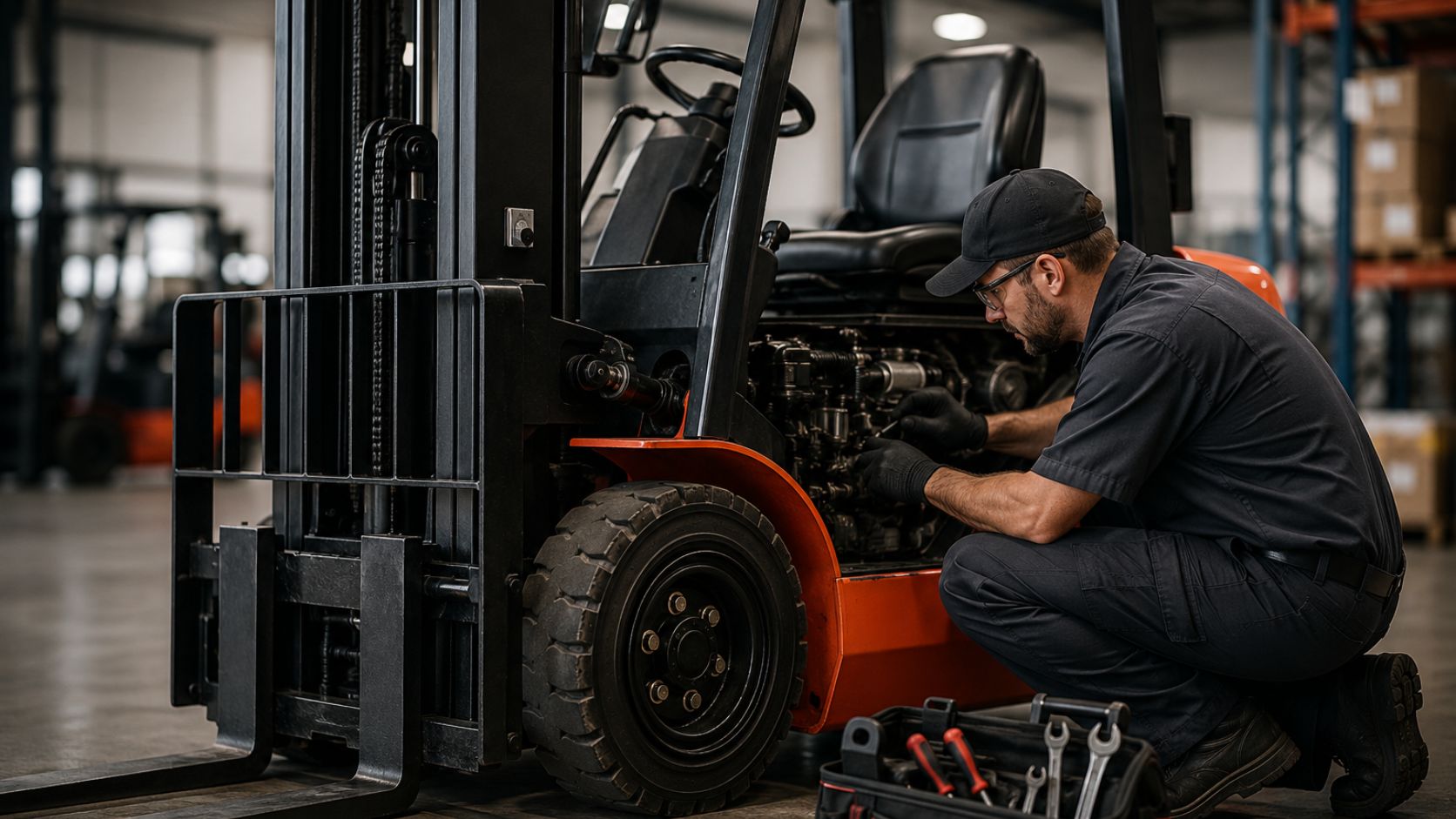
A thorough PM produces a service record that shows what was inspected, what was found, what was done, and what was recommended for follow-up. A transactional PM produces a checklist with a signature.
Ask for a sample of the service documentation the vendor will produce. If they hand you a one-page form with checkbox fields, that’s the quality of documentation you’re getting. If they hand you a multi-page report with findings, photos, and recommendations, that’s a different product.
What’s the team continuity?
If the vendor’s tech rotation means a different person services your fleet every visit, the institutional knowledge of your specific machines, your facility, and your operational patterns gets lost. Each visit starts from scratch.
Ask how the vendor structures account assignment. If they have a small team of dedicated technicians who rotate through your account specifically, you’re getting institutional knowledge as part of the service. If they rotate through a pool of 60 or more technicians based on availability, you’re getting whoever’s on shift that day.
Red flags in any maintenance agreement
A few specific patterns that indicate a maintenance agreement, in either form, isn’t structured to actually serve your operation:
- PM visit duration under 60 minutes per machine: As covered above. The visit is a checklist, not an inspection.
- Documentation that’s “available on request” rather than standard: A vendor who treats documentation as optional treats it as overhead, not as part of the service. When you actually need that documentation for an audit or insurance review, you’ll be chasing it.
- Pricing re-quoted after each visit: Pricing should be defined in the agreement, not adjusted per-visit. Per-visit re-quotes create margin opportunism on the vendor’s side.
- Recommendations that lean toward replacement before troubleshooting: A vendor whose first response to a fault code is “you should consider replacing this machine” before any meaningful diagnostic work is operating on a sales motivation, not a service motivation.
- Service teams that change every visit: Discussed above. Institutional knowledge is part of what you’re paying for.
- Emergency response with no contracted SLA: “We’ll get there as fast as we can” is not a service commitment. Contracted SLAs with response time defined per facility are standard for serious fleet operations.
- Heavy upsell on new units during service calls: If service calls consistently turn into sales conversations, the vendor’s compensation structure is built around equipment sales, and the service is a vehicle for that. Recommendations get distorted accordingly.
How to evaluate any maintenance agreement
Questions to ask any vendor
Before signing any maintenance agreement, planned or full, walk through these questions with the vendor:
- How long does your typical PM visit take per machine?
- What’s included in the PM scope, and what’s specifically excluded?
- Can you show me a sample of the service documentation I’d receive?
- How is your service team structured? Do I get a dedicated team rotating through my account, or whoever’s available?
- What’s your contracted emergency response SLA?
- How is pricing structured? What’s the rate for repair work outside the agreement, if applicable?
- What happens if my fleet has unusually high repair volume? Does that increase my fees, or does the vendor absorb the variance?
- What documentation do you provide for OSHA inspections, insurance audits, and internal compliance reviews?
- What’s your parts sourcing process for repairs that need parts not on the truck?
- How is your team compensated? Are technicians paid on completed visits, hourly, or some other structure?
The answers will tell you what kind of vendor you’re actually dealing with. Pay attention to which questions the vendor handles confidently and which they deflect or speak vaguely on.
Running the numbers
Beyond the qualitative evaluation, run the math on your specific situation. Three numbers matter:
- Your current annual maintenance spend: Total of PM costs, repair costs, parts costs, and emergency service spend over the last 12 months. If you don’t know this number precisely, getting an estimate is itself a useful exercise.
- Your current annual downtime cost: Number of unplanned breakdowns multiplied by hours of downtime per incident multiplied by hourly cost of a forklift being out of service. For a 10-unit fleet on reactive maintenance, this typically lands somewhere between $5,000 and $50,000 a year depending on operation type and fleet age.
- Your projected costs under each agreement type: What would a PM-only agreement cost annually, plus expected repair work? What would a FM agreement cost annually? How does each compare to your current spend?
The math frequently surprises operations that haven’t run it before. Operations on cheap PM-only programs with high reactive repair frequency sometimes find that an FM agreement is cheaper in total cost despite higher PM line items. Operations on heavy FM programs with low actual repair frequency sometimes find they’re paying for risk transfer they don’t need. The agreement type that’s right for your fleet depends on your actual numbers, not on industry generalizations.
We built a calculator that runs this math interactively. If you want to use your actual fleet numbers, that’s the fastest way to see what your situation looks like. If you’d rather work through the math directly, the framework above is what the calculator is doing under the hood.
How R&R structures programs
Our perspective, briefly
We’re a forklift fleet service specialist based in Central Texas. We’ve been doing this since 1993. A few principles that shape how we structure programs, which you can use as a benchmark for evaluating any vendor including us:
Service is our entire business: We’re not a dealer with a service department. We don’t have new-unit quotas shaping our recommendations, and our technicians’ compensation is structured around service work rather than equipment sales. We do sell pre-owned forklifts to existing fleet clients who need to add or swap a unit, but it’s a client accommodation rather than the primary revenue engine.
One team, every machine: A small team of dedicated technicians rotates through your account. By your fifth service call they know every machine in your fleet, every operator’s habits, and every quirk in your facility. Institutional knowledge is part of what you’re paying for.
Thorough PM, not transactional PM: Our PM visits run 90 to 120 minutes per machine. That’s roughly twice as long as a typical dealer PM, because the inspection actually inspects. We catch developing issues at the PM stage that turn into emergency repairs in two to eight weeks if missed.
Documented fleet service: Every service call produces a machine-level record. Fleet program clients receive consolidated monthly fleet reports designed for compliance review, insurance audits, and internal reporting without reformatting.
Pricing against downtime cost: Program pricing is structured against the downtime cost the program prevents, not against the hourly rate of individual repairs. If the math doesn’t clearly favor the program over your current spend, we’ll tell you that directly.
We structure both PM-only and full-maintenance program options depending on what fits your operation. The right structure depends on your fleet, your usage, and what you’re trying to accomplish. The conversation usually starts with a no-cost site walk where we look at your fleet, walk your facility, and benchmark what your current setup is producing against what a program would look like.
The agreement type you choose matters. The execution behind it matters more.
Both planned maintenance and full maintenance agreements can be structured well. Both can be structured badly. The right choice for your fleet depends on your actual numbers, your operational situation, and the quality of execution from the vendor on the other side of the agreement.
If you’re evaluating maintenance agreements for your Central Texas forklift fleet, we’d be happy to walk through your specific situation and benchmark what we’d offer against what you’re currently doing. No commitment, no pressure. Just a conversation about whether what we run would serve your operation better than what you have today.