Most fleet operations stick with their forklift maintenance provider out of inertia rather than evaluation. The vendor was there when you started, switching feels like friction, and as long as nothing is obviously broken, the relationship continues. The problem is that “nothing obviously broken” is a low bar. A lot of mediocre vendor relationships clear it while quietly costing the operation more than they should.
This guide is a 10 point framework for evaluating whether your current forklift maintenance provider is actually serving your fleet well. Each point is a specific, observable test, not a vague quality dimension. You can run this framework on your current vendor using your own service records and your own experience. You come out the other side with a clear answer: keep them, push them to improve, or start looking.
We’re a forklift fleet service specialist, so we have an interest in you concluding that your current vendor falls short. We’ve tried to write the framework honestly enough that you could run it on us and get a fair result. The tests are real. Use them on whoever you’re evaluating, including us.
The maintenance quality tests
Test 1: How long does a PM visit actually take?
Pull your service records and look at the time stamps on your last several PM visits. How long was the technician actually on site per machine?
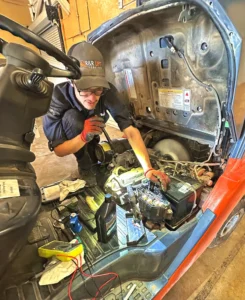
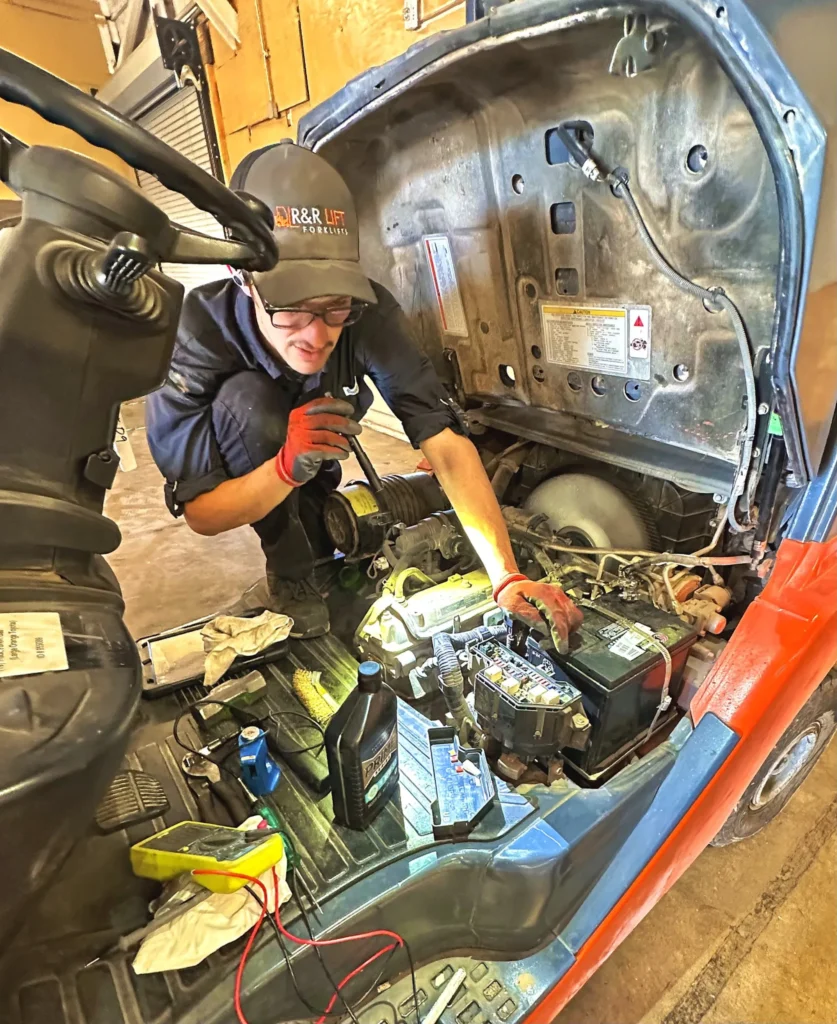
Thorough preventative maintenance runs 60 to 120 minutes per machine, depending on machine type and operating environment. A vendor whose PM visits average 30 minutes per machine is running a checklist, not an inspection. They check fluid levels and filters and move on. That means the developing issues thorough PM catches (mast chain wear, hydraulic line fatigue, brake component wear) go uncaught until they fail.
The test: If your PM visits consistently run under an hour per machine, your PM is probably performative. It isn’t preventing much, no matter what you pay for it.
Test 2: What does your PM documentation actually contain?
Look at the last PM report your vendor gave you. What’s in it?
A thorough PM produces a service record showing what was inspected, what was found, what was done, and what’s recommended for follow up. A performative PM produces a checklist with checkmarks and a signature. The difference tells you how much actual inspection happened.
The test: If your PM documentation is a one page form with checkboxes and no substantive findings, your vendor isn’t doing real inspection, or isn’t documenting it. Either way, you’re not getting the value thorough PM provides.
Test 3: Are issues caught before they fail, or after?
Think about your last several forklift breakdowns. Were they surprises, or had a prior PM visit flagged them?
The entire point of preventative maintenance is catching issues before they cause unplanned failures. Suppose your machines break down with problems that should have been visible during a recent PM: a hydraulic line that had been weeping, a brake system that had been wearing, a battery that had been declining. Then your PM isn’t catching what it should.
The test: If your breakdowns are consistently surprises that a thorough PM should have caught, your preventative maintenance isn’t actually preventing.
The responsiveness tests
Test 4: Is your emergency response time predictable?
Think about your last several emergency calls. How long did the vendor take to respond each time?
The issue isn’t just average response time. It’s consistency. A vendor who shows up within hours sometimes and the next day other times produces unpredictable downtime. That is harder to manage than a slower but steady response. Fleet operations can plan around predictable response. They can’t plan around variable response.
The test: If your vendor’s emergency response time swings widely from call to call, and especially if no contract defines what response you’re entitled to, you’re getting whatever response the vendor feels like providing on a given day.
Test 5: Do you get the same technicians, or a rotating cast?
Think about who actually shows up for your service calls. Is it a consistent small team, or a different person each time?
Technician continuity matters more than it seems. A consistent team learns your fleet, your operators, your facility, and your equipment history. Each service call builds on the last. A rotating cast of technicians starts from scratch every time. That means slower diagnostics, less consistent repair quality, and operators explaining the same context again and again.
The test: If you can’t name the technicians who service your fleet because they’re always different, you’re losing the institutional knowledge that makes a service relationship actually valuable.
Test 6: How does the vendor handle parts availability?
Think about your repair turnaround times. When a repair needs a part the technician doesn’t have on the truck, how long does the repair take?
A vendor with good parts sourcing (strong OEM relationships, a network of quality leading aftermarket suppliers, sensible truck stock) resolves most repairs quickly. A vendor with weak parts sourcing leaves machines down for days waiting on parts that should have taken a day or less to source.
The test: If repairs routinely stall for days waiting on parts, your vendor’s sourcing is adding downtime cost that a better sourced vendor wouldn’t.
The trust and economics tests
Test 7: Do recommendations lean toward repair or replacement?
Think about the recommendations your vendor makes on aging machines. When a machine has an issue, does the vendor troubleshoot and repair, or do they steer toward replacement?
A vendor whose first instinct on an aging machine is “you should think about replacing this,” before exhausting reasonable repair options, may be working from a sales motivation rather than a service motivation. Customers tell us they have seen this most with dealers whose broader business includes equipment sales.
The test: If replacement recommendations come up disproportionately, especially before thorough troubleshooting, ask yourself whether your vendor benefits from selling you new equipment. If they do, their recommendations carry a built in conflict of interest.
Test 8: Has your pricing stayed predictable?
Look at your billing over the past year or two. Has pricing held steady, or has it drifted upward without clear justification?
A vendor with defined rate structures bills predictably. A vendor who quotes again pricing on every visit, or lets rates drift, creates margin opportunism that’s hard to spot in any single invoice but adds up over a long term relationship.
The test: If your costs have crept up without a corresponding change in service scope, or if you can’t predict what a given service call will cost before it happens, your pricing structure is working in the vendor’s favor and against yours.
Test 9: Could you produce compliance documentation on demand?
Imagine an OSHA inspector or your insurance carrier asks for your forklift maintenance and inspection records tomorrow. Could you produce them, complete and current, without scrambling?
A vendor who treats documentation as a standard deliverable keeps your records current and ready to forward. A vendor who treats documentation as optional leaves you scrambling to reconstruct records when you actually need them.
The test: If you’d have to chase your vendor to assemble compliance documentation, or if the documentation would come back incomplete, your vendor isn’t providing the documentation a serious fleet operation needs.
Test 10: Does the vendor know your fleet, or just service it?
This is the synthesis test. Does your vendor understand your fleet as a whole, or do they just handle individual service calls?
A vendor who knows your fleet can tell you which machines are trending toward lifecycle decisions, where your recurring issues cluster, and how your maintenance spend is trending. A vendor who just handles individual calls has no view of the fleet as a system. That means no proactive guidance and no strategic value beyond fixing what breaks.
The test: If your vendor has never proactively told you something about your fleet that you didn’t already know (a machine to watch, a pattern across your equipment, a budgeting heads up), they’re a service vendor, not a service team that knows your fleet.
Scoring your provider
How to interpret the results
Run all 10 tests on your current vendor. The pattern of results matters more than any single test.
Mostly passing (8 to 10 tests pass): Your vendor is genuinely good. Whatever frustrations you have are probably about specific incidents rather than systemic problems. Keep them, and don’t switch for marginal reasons.
Mixed (5 to 7 tests pass): Your vendor is adequate but not strong. There’s room for improvement. Consider whether a direct conversation with the vendor can fix the failures, or whether they’re structural (a dealer’s sales conflict, a vendor too large to give your fleet attention) and unlikely to change.
Mostly failing (4 or fewer tests pass): Your vendor isn’t serving your fleet well. The relationship is probably costing you more than you realize in downtime, premature replacements, and lost institutional value. It’s worth seriously evaluating alternatives.
What to do with a mixed result
A mixed result is the most common and the most actionable. Some vendor problems are fixable through a direct conversation. If your vendor’s PM visits have gotten short, or documentation has gotten thin, raising it directly sometimes produces improvement, especially if you’re a valued account.
Other problems are structural and won’t change. A dealer’s sales conflict on replacement recommendations isn’t going away because you asked. A vendor too large to prioritize your mid size fleet won’t suddenly start giving you attention. For structural problems, the only real fix is a different vendor.
The test for whether a problem is fixable: is it about execution, which can improve, or about structure, which can’t? Execution problems are worth a conversation. Structural problems are worth an evaluation of alternatives.
Where R&R fits
Run the framework on us
We encourage you to run this exact framework on us as part of any evaluation. Here’s how we expect to score on the structural tests:
- PM duration (Test 1): Our PM visits run 90 to 120 minutes per machine.
- Documentation (Tests 2 and 9): Standard machine level records and monthly fleet reports, structured for compliance and audit.
- Technician continuity (Test 5): A small dedicated team rotating through your account, not a large pool.
- Replacement recommendations (Test 7): We sell forklifts too, so hold us to this test. Ask for the repair option first and the reasoning behind any replacement recommendation.
- Fleet knowledge (Test 10): Lifecycle recommendations and fleet reporting are built into our program structure.
On the execution tests (response time consistency, parts availability, pricing predictability), we ask you to talk to operations we currently serve rather than take our word for it. Execution is proven in practice, not claimed in marketing.
The benchmark conversation
If you’ve run the framework on your current vendor and the result is mixed or worse, the next step is a benchmark. We do site walks where we look at your fleet, understand your current situation, and show you what a program with us would look like compared to what you have today. If our program clearly beats your current setup, that’s worth knowing. If it doesn’t, we’ll tell you that too.
A vendor relationship is worth evaluating, not just continuing.
Inertia keeps a lot of mediocre vendor relationships alive. The 10 point framework above gives you a structured way to evaluate whether your current provider is genuinely serving your fleet or just clearing the low bar of “nothing obviously broken.” Run it honestly. If your vendor passes, you’ve confirmed a good relationship. If they don’t, you’ve identified a problem worth solving.
If you want a benchmark against what a different provider would offer, that’s what a site walk with us provides. No commitment, no pressure, just a clear comparison so you can decide with real information. Call 512-256-5312 or use the form at /contact/.